Tuesday, September 27, 2016

Week Six: The Hobbit


I've been wanting to read "The Hobbit" since my early high school days but, for some reason, never got around to doing it until I saw it as the reading for this week. Nevertheless, I thoroughly enjoyed it, and I can definitely see the appeal to the Lord of the Rings series. Reading "The Hobbit" gave me flashbacks to books like the Septimus Heap series and the Eragon series of my middle school days with its fantasy epic nature and a very distinct "hero's journey" plot line. I particularly liked the episodic nature of "The Hobbit", where the gang encounters dangers one after another but always makes it out in the end. Bilbo Baggins is also a classic, but reluctant, hero, and repeatedly saves the group from each situation. Ironically, despite his attempts to live a normal life, Bilbo is the most exceptional of them all, using his wits and light of step to save all the dwarves on countless occasions. "The Hobbit" follows the hero's journey storyline fairly well, with Gandalf calling Bilbo to adventure, and eventually leading him to cross the first threshold with the troll and goblin fight. The enemies they face grow stronger as the story progresses and peaks when the dragon Smaug is defeated and the dwarves achieve their goal. Bilbo then reaches his apotheosis when he finds the Arkenstone, and then proceeds to negotiates peace between the dwarves and the elves and band them together to defeat the goblin army. Of course, Bilbo returns to his old home with some treasure and is able to continue with his life, now with a few experiences and accomplishments under his belt.

Monday, September 19, 2016

Week Five: Witches

For this week, I read a couple of short stories: "The Cinder Maid", "Fair, Brown and Trembling", "The Baba Yaga", and "The Wicked Stepmother". Though all dealt with witches and magical females, there seemed to be a common element among the stories: the presence of an evil, older woman who threatened the livelihood of the young, female protagonist. This bad witch is usually a relative (an evil stepmother) and is noticeably jealous of the protagonist's youth and beauty, both of which she used to have but presumably no longer possesses because her aging. As we discussed in class, this motif of sorts applied to a lot of fiction about witches and even the idea of witches in general. Perhaps this is the manifestation of a misogynistic view of age on women as an undesirable trait, or maybe it is simply the result of a classic fairy tale cliche. However, I also noticed that these stories usually had a "good" older woman as well, one who gives the young protagonist what she needs to fight the evil power of the bad witch. This good woman usually takes on the fairy Godmother role, as we see in "The Cinder Maid" and "Fair, Brown, and Trembling", and supplies the girl with magical items and charms. In these stories, the "good witch" and "bad witch" take a very active hand in shaping the growth of the young heroine and essentially influence her upbringing. Thus if I were to draw a "moral of the story" from these tales, I would pin it to be more about how aging affects a person's character, whether they become spiteful of the youthful generation or if they instead support the youth and give them the necessary tools to continue building the future. The good witch embraces her age and is at peace with it. She uses her own powers and wisdom, which she earned with age, to help the young girl in building her own life and setting her on her own path. The bad witch is envious of the youth, and constantly has to put down the young girl to boost her own ego. She uses her powers to prevent the youth from surpassing her and is adamant in keeping her power, unable to acknowledge her own aging. To the girl, the existence of these two witches can also act as a warning, since later on in life, the girl has to make her own decision on whether she becomes the good witch or the bad witch. And inevitably, we too will have to choose which path to walk down.

Sunday, September 11, 2016

Week Four: The New Weird

The genre of the "New Weird" is definitely... weird. For this week, I read Lovecraft's "The Unnamable" as well as "What the Moon Brings". As a classic writer of weird fiction, Lovecraft's two short stories both gave off a sense of the surreal and the supernatural. In both stories, we can sense the presence of an outer supernatural force, a kind of cosmic power that exceeds the capabilities of our human understanding. This feeling of the "inexplicable" and mystery may be what categorizes these stories as "weird". Yet I feel that this feeling of the inexplicable is also what draws the audience into the story, and what captivates the audience to stay. I liked "The Unnamable" especially because it was truly best told by word as a story, its medium is fitting of the subject. As an artist, I tend to interpret things visually in my mind, but "The Unnamable" was purposely visually ambiguous. Thus, when told in the form of words, we- the audience- only experience the "unnamable" through someone else's account of the monstrous encounter. We experience the narrator's experiences second-hand, and the "unnamable" monster's appearance is thus passed through a filter if sorts before it reaches us. That element of writing has always fascinated me, and a concept that I hope to play around with in my future artwork.

Another interesting aspect of "The Unnamable" was its sense of irony and even self awareness. One of the main characters eventually commits the same character trope that he was disparaging moments before. Such a twist reminds me of other self-aware horror films such as "Scream" or "Cabin in the Woods" in which they poke fun and even satirize common tropes of the same genre that they occupy. This not only provides witty commentary on "genre fiction" but can also be entertaining to an audience jaded by the repetitive elements of the horror genre. I personally enjoy this type of irony since it seems to give second wind to a category of film and writing that is so riddled with cliches. Of course, I also enjoy it because its humorous when done well and can turn something that should be scary into something to be laughed at. When works don't take themselves too seriously like that, its not as intimidating to the audience and also acts as a great area of respite between all the other "edgy" pieces out there. As long as speculative fiction continues to exist, so will counter-fiction and satire, and I hope to consume many of both categories in the future.

Saturday, August 27, 2016

Week Three: A Wild Sheep Chase


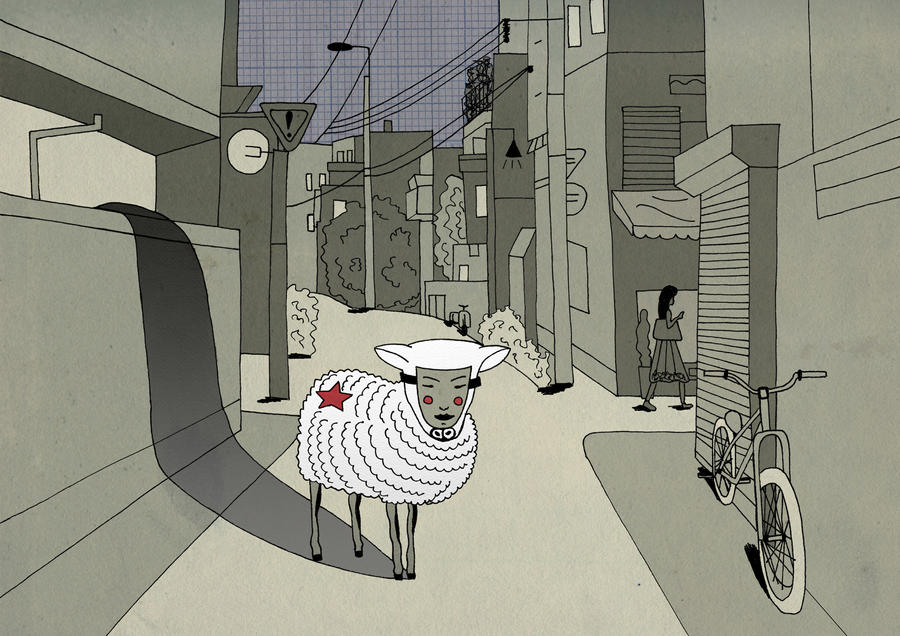
Upon the first impression, A Wild Sheep Chase seemed like an average story about an average guy dealing with middle age and existential crises. Yet even though it is a "ghost" story, the world and characters that Murakami builds seem very rooted in reality. The narrator's day-to-day conversations are scattered frequently throughout the novel, embellishing his narration with reminders that he is a normal person leading a normal life. Up until the narrator is called upon this wild sheep chase, he is shown to hold a job, have trouble with his marriage, and have a few past relationships- all in all, a normal man. He isn't even given a full name, like many of the other characters in his life. However, what I found interesting is that even with all this realistic world building and development, Murakami spins a tale about a supernatural sheep, whose influence has existed since the beginning of time. Eventually, the mood of the novel moves from one of realism to one of uncanniness and surreality, as more about this sheep is revealed. Having these two very different sides of the world side by side presents a very captivating premise. It feels as if the narrators "adventures" could really happen to anybody, even me. Even with the supernatural aspects of the novel, I felt as if Murakami's world was palpable and that I was immersed in it. I'm pulled in to the plot by the realist interactions of the protagonist and the small details of his life. I loved all the effort put into building I's personality and past, and how it all cumulated in his subsequent sheep chase.

Tuesday, August 23, 2016

Week Two: Interview with the Vampire


The classic vampire story has come a long way since the days of Dracula and the European vampires of old. Contemporary vampire lore has transformed the life stealing blood sucker into a creature with human relationships and even human values. However, the essence of the vampire has not changed. The foundational idea of vampires is that they are still creatures who take and steal from others, sometimes "corrupting" them to become vampires just like them. But in a modern setting, what the vampire steals may not always be literal blood, and they don't need to have fangs and superhuman abilities to be a "vampire". Humans can also exhibit "vampiric" traits by stealing other people's happiness, by feeding on their misfortune, or just leeching off of their property, instead of blood. Anne Rice, however, still writes her characters as literal vampires, but exhibiting human traits and thought processes. Interview with the Vampire explores the relationships formed by these vampires, and the consequences of their relationships when immortality and moral dilemma are thrown into the mix.
To Louis, our protagonist, Lestat had become a vampire in the truest sense. He took from Louis his humanity, his money, and-for a period of time- his freedom. Not only did he suck Louis's blood, he also sucked Louis emotionally, forcing Louis to stay with him out of guilt and necessity while leeching off of his money and land as well. Yes, he was a traditional blood-sucking vampire, but he was also a vampire in the sense that he sucked Louis's livelihood, fortune, and freedom. However, he also severely depended on Louis in order to sustain his lifestyle. Unable to handle money wisely, and desperate for companionship, Lestat relied on Louis for both. Just like a traditional vampire, who depends on blood for life, Lestat fed on Louis's wealth and skills for life. Louis was the blood upon which Lestat sustained his life (other than the literal blood which he also fed on). As a result, Louis felt emotionally drained and constantly desires to leave Lestat. Anne Rice has thus written a dynamic where the "vampire" not only sucks blood,  but exhibits human "vampiric" traits such as being a manipulative person and leeching off of others.

Sunday, August 21, 2016

Week One: Frankenstein

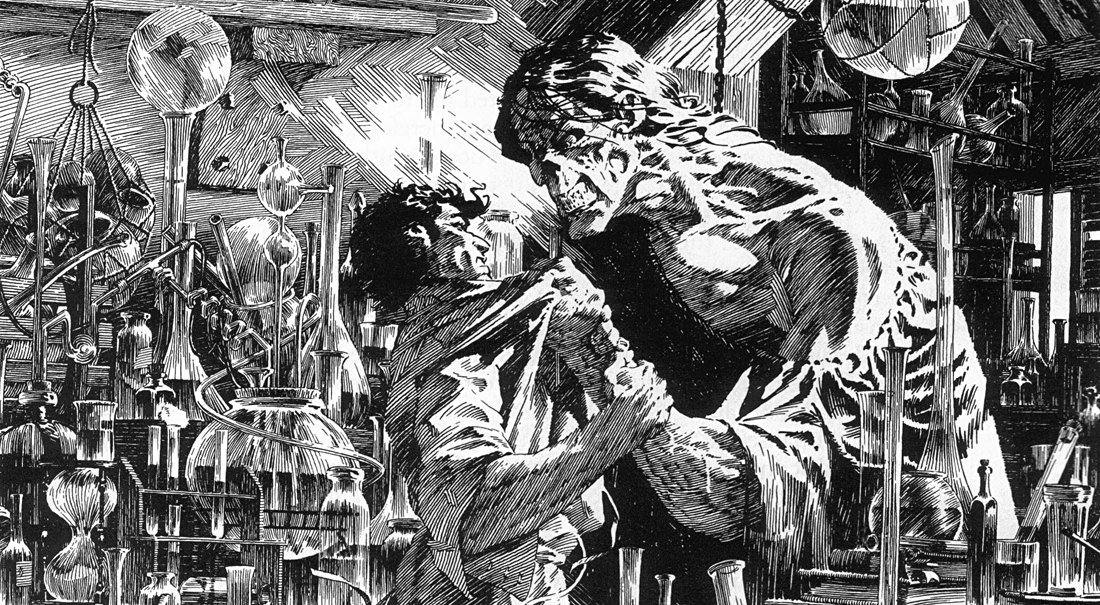
The imagery of nature is a powerful motif in Mary Shelley's Frankenstein, and is almost a mocking presence to Victor, who strives so earnestly to to imitate it, artificially creating life in a vain attempt to mimic nature's effortless beauty. The picturesque scenery of Switzerland is always present, sometimes giving Victor a false sense of happiness during trying times. However, it acts more frequently as a moment of rest for the audience, so that the novel isn't a continuous stream of depressing events one after another. Instead, there is always peace before the storm, a period of calm before the characters are thrown into turmoil, creating a story that repeatedly raises and drops the character's- and the audience's- emotions. These "calms before the storm" occur often throughout the novel, and are usually achieved through detailed descriptions of nature, evoking its sublime power. For instance, when Victor is returning to Geneva after hearing news of William, he travels through a breathtaking landscape of placid waters and snowy peaks, with Shelley not sparing a single detail of the grand splendor of his surroundings. In this environment, even our melodramatic hero notes a feeling of peace washing over him. This journey being framed by the beautiful foliage of nature serves as a period of respite from the terrible events preceding and immediately following the journey. It is the calm before a literal storm which, of course, eventually descends rapidly and without warning upon Dr. Frankenstein, once again returning him to a state of despair.
In other instances, the beautiful scenery of Switzerland acts as an ironic backdrop to Victor's state of mind and his experimentations. The vivid imagery of the landscape only highlights the stark contrast between natural life and the life which Victor created in a poor attempt to emulate it. His experiments only succeed in making a cheap, failed imitation of life, his surroundings forever a reminder of his failure. Thus, Shelley would often paint a lush picture Switzerland, teeming with natural charm and effortless beauty, only to have Victor wallowing in misery amid the fresh blooming flowers. The contrast between the beauty of the landscape and the dark thoughts of Victor conveys to the audience the pitiful struggle of man against nature and puts into perspective the hopelessness of Victor's struggle to overpower it.